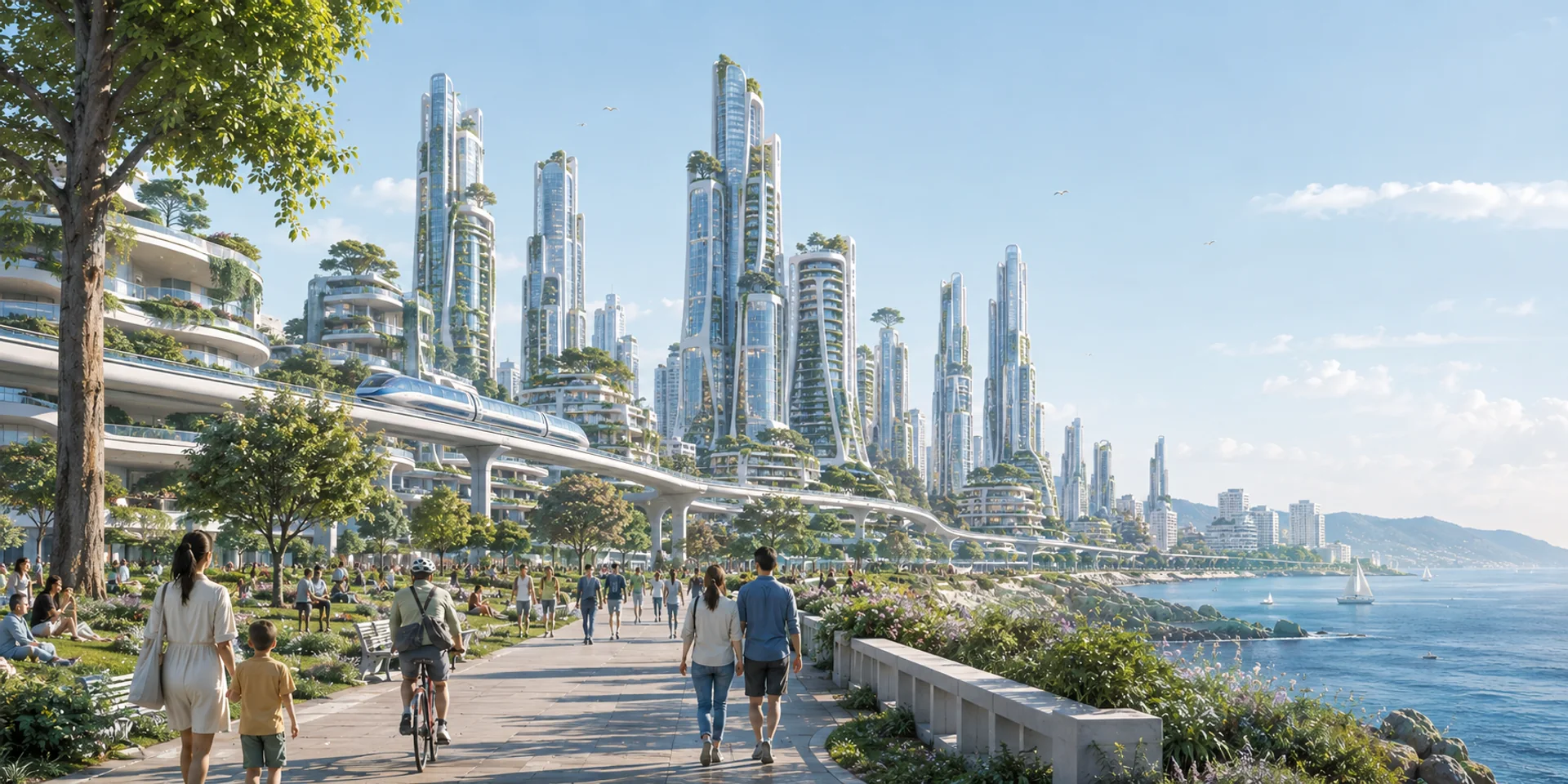
I want my daughter to grow up in a world where the cost of an AMAZING life is close to zero.
Where everyone can access great healthcare, education, products and services. Where people have the freedom to choose how to spend their days.
That is the ambition behind Free World. My life mission is to use AGI, automation and radical innovation to drive the cost of valuable things toward zero at scale, so everyone can access them.
Think about photography. We once paid for film, developing it and printing photos. Today, we can take thousands of photos on a phone at almost no additional cost. Something we used to ration became something we barely think about paying for.
What if we could do the same for almost everything people need?
Coming from a less wealthy country, dealing with personal health problems and eventually finding my way to San Francisco has made this mission personal. I'm fortunate enough to be able to choose what to work on and ask how I can help humanity the most. I'm still figuring out the details, but this is what I want to spend my life on.
I'm writing in a personal capacity. I'm NOT offering a product or service here. I'm sharing the future I believe we can create and the approach I want to explore. I want to meet people who want to help make it happen.
Over the next 30 days, we will run hundreds of experiments to test the limits of today’s technology, open-source everything we build, and freely share our setup, results and limitations so anyone can build on them. We believe deeply in this mission and want to work towards it with people around the world, so leave your email to follow along or hit me up if you want to contribute.
Why do I believe this is more relevant right now than ever before?
Think about how much of our lives we spend working to afford healthcare, education, food and housing. Each depends on expertise, problem-solving and coordination across many organizations. AI can already help people with parts of that work. What interests me is how far it could bring the cost of those essentials down.
The goal is to make useful things almost free and give people more freedom over their time. One question I want to explore is how far autonomous companies could go without humans in the loop. If a system could reliably deliver a service at close to the cost of computing and electricity, we could make it accessible to far more people.
Five trends in the AI development race are making this future increasingly possible:
- AI models are getting smarter: Stanford reports that benchmarks designed to remain challenging for years are being saturated in months. Related research: Stanford AI Index
- AI intelligence is getting increasingly cheaper: Epoch measured a median 50x annual drop in inference prices at fixed benchmark performance, rising to 200x annually when looking only at data from January 2024 onward. Related research: Epoch AI
- Agents can handle longer tasks: In January 2026, METR reported that Claude Opus 4.5 could complete tasks taking humans roughly five hours, with 50% success, mostly in software and research. The long-term trend doubled every 6–7 months. Related research: METR
- Agents are becoming faster: OpenAI reports roughly 65 tokens/second for GPT-5 and GPT-5.2, versus over 1,000 for GPT-5.3-Codex-Spark on specialized hardware: about 15x the output speed, or roughly a 1,400% increase. Related research: OpenAI
- AI is getting mechanical bodies: they are slowly entering the physical world. Source: BMW Group
What could the next few years make possible?
Let's explore a hypothesis: within the next two years, we develop AGI with intellectual capabilities beyond any human on the planet. Over the following couple of years, we can “just” instruct AGI to go and build fully autonomous companies that would drive the price of digital goods and services toward zero. Once AGI enters the bodies of robots instead of servers, we will be able to push the prices of physical goods and services toward zero as well.
Imagine a world where:
- AGI performs most digital work, including much of the research, design and coordination behind physical products.
- Robots work across every industry, helping us grow food, manufacture goods, construct homes and maintain infrastructure.
- Transportation is fully autonomous, moving people and goods with far less human work.
- Energy becomes abundant and radically cheaper, with commercially viable nuclear fusion contributing to that supply.
What interests me is how these technologies could help expand one another. AGI could design better robots and energy systems. Robots could build the infrastructure needed to produce more of them, while cheaper energy could make that expansion less expensive. Those gains could spread through connected industries.
Today’s AI token prices offer an analogy: while OpenAI and Anthropic (pioneers of innovation) keep margins high, other players are open-sourcing their models and gifting things at a fraction of the cost. Autonomous companies will empower many people to drive costs down across industries, even as many brands keep charging high prices.
My hypothesis is that AGI technology, combined with competition and expanding access, could make all goods and services radically cheaper. My ambition is to help keep pushing those costs toward zero.
Will those possibilities reach everyone?
That is the part I don't think we can take for granted, and we must fight for it.
A company could become dramatically cheaper to run while charging its customers the same prices. An extraordinary treatment could exist while remaining out of reach for most people. A growing economy could leave many workers struggling.
Anthropic's scenarios show how greater economic output could come with job losses and a larger share of income going to owners of capital. More production does not automatically mean everyone benefits. Anthropic
I want to help build a world where profitable businesses compete to deliver more value to more people at lower prices. Where making something widely accessible can be a successful business in itself. Where companies with people in the loop can use the same advances to offer radically lower prices too.
That is what made me fall in love with capitalism: the possibility of people building better things, finding better ways to provide them, and making them accessible to more of humanity.
Someone should not need to understand AI, own a robot or know how to build an agent to receive better care, afford a home or get an education.
And lower prices only help if people can actually access what they need. The transition has to work for people whose jobs and incomes change too.
So what now?
With a group of friends, I'm exploring a question: how much useful work can autonomous systems do?
The experiment is to build an autonomous system that does everything needed to run a business: builds and improves products, keeps them running, handles customer support, responds to e-mails, and finds and communicates with customers.
It would also have access to and use my LinkedIn profile as part of my digital identity, sharing what we build and talking to people on my behalf. We want to see how far it can take the whole process on its own, from building something to getting it into people’s hands and learning from their feedback.
As DeepMind and OpenAI started with the gaming industry, we will do the same.
We will start by building and open-sourcing all sorts of retro games, making them accessible and affordable to everyone. We will then increase the complexity of the new games and slowly expand into other industries.
We will share almost daily updates on everything we try over the next 30 days.
Leave your email to follow along, or hit me up on LinkedIn if you want to contribute.
Let’s hope for the best, because if this works, the future for everyone will be amazing!